
Description
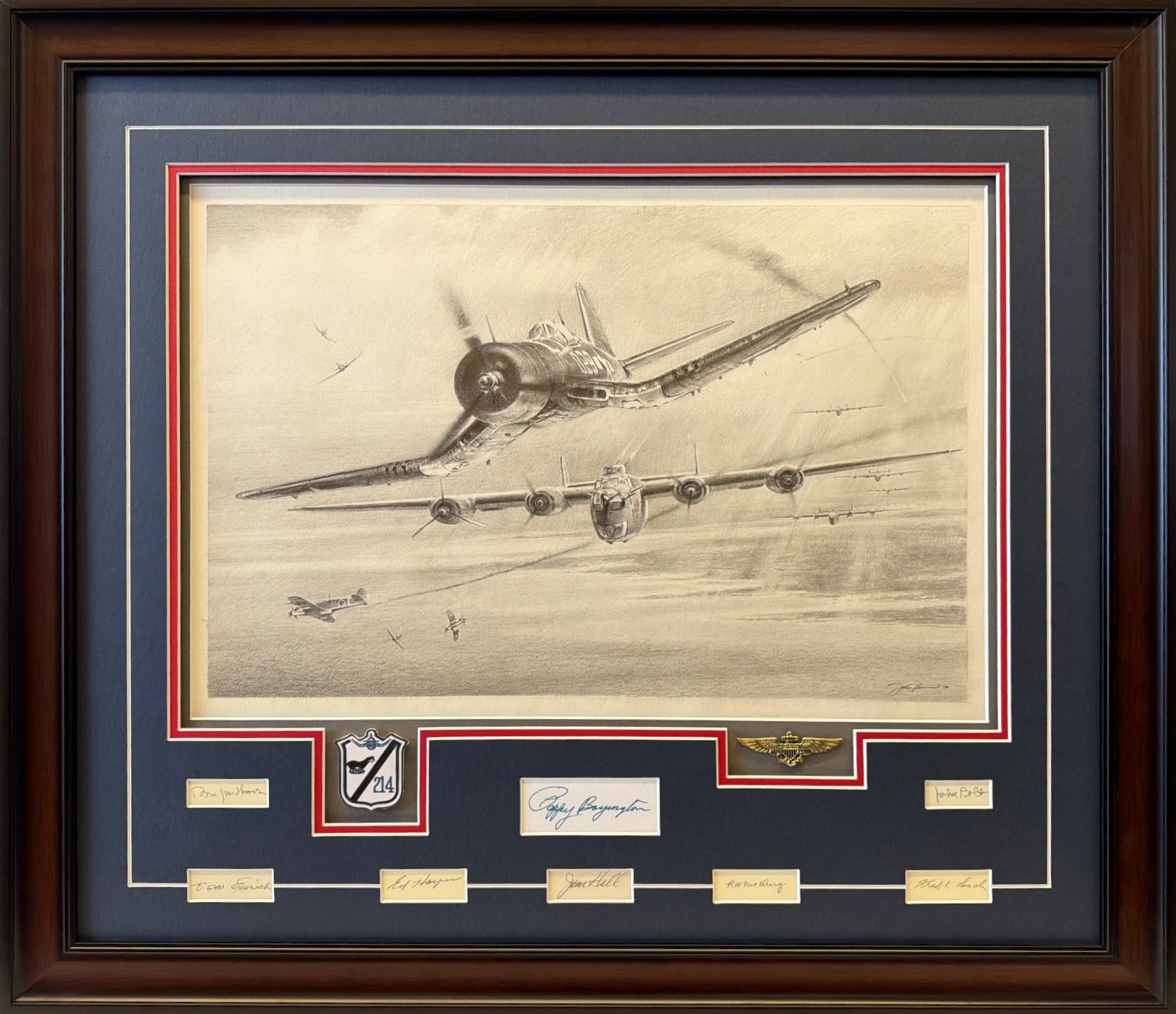
Marine Corsairs of VMF-214 – The “Black Sheep” – protect B-24 Liberators from marauding Japanese Fighters.
This outstanding original pencil includes the autographs of Eight Black Sheep pilots, including two of their most famous Aces.
Captain FRED S. LOSCH USMC
Hailing from Pennsylvania, Fred Losch joined the “Black Sheep” as a replacement pilot on November 10, 1943. On January 2, 1944 he downed a Zero and damaged another over Rabual. With VMF-214 he flew 28 combat missions and then served a second tour with VMF-211.
Lieutenant Colonel W. THOMAS EMRICH USMC
Thomas Emrich joined VMF-214 on August 7, 1943, flying two combat tours with them. On October 15th, 1943, he shot down two Zeros in aerial combat over Kahili, but the next day, on a fighter sweep, had to ditch off Vella Lavella and be rescued by a PT boat. He flew 68 missions with the “Black Sheep” and then a third tour with VMF-211 with other former “Black Sheep” pilots.
Colonel EDWIN A. HARPER USMC
Born in Canada, Ed Harper joined VMF-214 on August 7th, 1943 and flew both tours until January 1944, scoring a victory and 2 probables on sweeps over Kahili and Rabaul. Wounded on October 17th, the next day he flew a mission and scored a probable over a Zero. Ed was reassigned to VMF-211 for a third tour after VMF-214 were disbanded in January 1944.
Lieutenant Colonel JOHN F. BOLT USMC
John Bolt is one of only seven American Aces to shoot down 5 or more enemy aircraft in both WWII and Korea, he was also the only Marine Corps Ace in Korea. Commissioned in 1942, he joined VMF-214 in 1943. Flying the F4U Corsair John Bolt downed six Zekes in just 90 days from September to December 1943 to become an Ace. He also saw action in the last few weeks of the war with VMF-472. Returning to combat duty in the Korean War, he served a tour with the marines before flying a tour with the Air Force where he shot down six MiG15s.
Lieutenant Colonel JAMES J. HILL USMC
James Hill was born in Chicago in 1920. he arrived in the South Pacific on June 5, 1943, after completing flight school in Pensacola, and joined VMF-214 on August 7th, 1943. He flew both combat tours with the “Black Sheep.” On October 18th, 1943, on a fighter sweep over Kahili Airdrome he shot down a Zero in aerial combat. During his two tours with the “Black Sheep” he flew a total of 70 combat missions, and also flew a third combat tour with VMF-211 on Green Island.
Lieutenant Colonel ROBERT W. McCLURG USMC
Bob McClurg left for the South Pacific on May 2nd, 1943, joining the VMF-214 “Black Sheep” on August 7th, 1943. He flew both the “Black Sheep” combat tours and was then transferred to VMF-211 for his third combat tour after the “Black Sheep” were disbanded. During the Squadron’s first aerial combat on September 16th, 1943 – an escort mission of torpedo and dive-bombers – Bob shot down a Zero over Ballale for one of the unit’s early victories, and his first. By the end of both his combat tours with VMF-214, he achieved 7 confirmed aerial victories and 2 probables, making him one of the unit’s top Aces.
Brigadier General BRUCE J. MATHESON USMC
Born in Chicago in 1921, Matheson enlisted in the Marine Corps in 1942 and joined the “Black Sheep” on August 7, 1943. On October 17, 1943, he shot down a Zero over Kahili but was wounded during the aerial combat. HE safely landed his badly damages Corsair at Munda. On January 3, 1944, Bruce got his last aerial victory and also confirmed Major Boyington’s final aerial victory before “Pappy” was shot down near Rabaul. BY the end of the second “Black Sheep” tour, Bruce would have 3 confirmed victories and 1.5 probables. For his third combat tour he was transferred along with 14 other “Black Sheep” pilots to VMF-211 on Green Island.
Colonel GREGORY “PAPPY” BOYINGTON Medal of Honor
Boyington is best known for flying the F4U Corsair with VMF-214 as the Commanding Officer. During his squadron’s first tour of combat duty, Major Boyington shot down 14 enemy fighter planes in 32 days. By December 27th, Boyington had 25 victories. His 26th victory came on January 3rd, 1944 over Rabaul, but he was shot down himself later the same day. Following a determined but futile search, Boyington was declared missing in action. However, he’d been picked up by a Japanese submarine and became a POW.
After the Japanese surrender, Boyington was liberated from Omori Prison Camp and returned to the US in September 1945. Shortly after his return, Boyington received the Medal of Honor. On October 4th, 1945, he received the Navy Cross for the Rabaul raid. Boyington retired from the Marine Corps on August 1, 1947 at the rank of Colonel.


Reviews
There are no reviews yet.